0 items - $0.00
No products in the cart.
Discover top-quality turbocharger products at Kool Wrap. Our range includes heat shields, protective sleeving, and insulation materials for enhanced performance and durability.
This guide shows you how to fit a turbo blanket, from the checks before you start through to the first heat cycle. Turbo blanket installation takes basic hand tools and a cold engine. The job is simple, but the details matter: the right orientation, even spring tension, and clear space around the wastegate and sensors.
If you have not bought yours yet, start with our turbo blanket range and make sure you have the right size.
Keep plastic cable ties away from the turbo. They melt.
Remove any factory heat shield that covers the turbine housing and keep it and its bolts together. Take off intake pipework if you need more room to work.
Wipe off oil residue and grime so nothing gets trapped under the blanket.
Offer the blanket up to the turbine housing with the stainless mesh side facing the metal. Line up the openings with the exhaust inlet flange, the outlet and, on internal wastegate models, the wastegate lever.
Pull the blanket snug so it sits flat, with no bunching and no bare housing showing beyond the flange openings.
Hook the stainless steel mounting springs into place as shown in the supplied instructions. Work across the blanket and alternate sides so the tension stays even. Do not overstretch the springs.
Make sure the edges around the flanges sit close to the housing and nothing hangs loose.
Run the clearance checks below before you refit anything.
Refit the factory heat shield if it still clears the blanket, then reconnect intake pipework and anything else you removed. If the factory shield no longer fits, call us before you leave it off. Route lines and wiring away from the blanket.
On an internal wastegate turbo, move the wastegate lever by hand through its full travel. It must move freely without catching on the blanket. On an external wastegate setup, check the blanket does not press against the wastegate or its pipe.
If your O2 sensor sits near the turbo outlet, keep the blanket edge clear of the sensor body and its lead. Never cover the sensor.
Oil feed and return lines, coolant lines, boost and vacuum hoses, and sensor wiring should not touch the blanket. The outer surface still gets hot, so give them clearance and secure anything that could move.
Close the bonnet and check nothing touches the blanket. Rock the engine gently by hand and make sure the blanket does not rub on the firewall, strut tower or chassis.
Some smoke on the first run is normal. Binders in the materials burn off as the blanket reaches operating temperature for the first time.
Kool Wrap turbo blankets carry a 12 month warranty.
If your turbo works in an oily or dusty environment, choose a silicone coated turbo blanket. The silicone-coated fibreglass outer resists oil and fuel. It suits trucks and plant engines, and anywhere oil and fuel are a risk. Fix any oil leak before you fit it.
Truck and marine operators can also browse our engine-specific industrial and marine turbo blankets.
The dump pipe after the turbo radiates heat too. Wrap it with exhaust heat wrap and secure it with stainless steel ties. Leave the O2 sensor unwrapped.
Together, the blanket and the wrap keep more heat out of the bay. Our step-by-step exhaust wrap install guide covers the method.
Want to know what your new blanket is doing for you? Read what a turbo blanket does.
Let the engine cool, clear access to the turbine housing, then test fit the blanket with the stainless mesh side against the metal and the openings lined up with the flanges and wastegate lever. Hook the stainless steel springs in alternating sides so the tension stays even, check the wastegate moves freely, then refit everything you removed.
Stainless steel mounting springs hook across the blanket and hold it closed against the housing. They are supplied with the blanket and the fitting instructions show where each one goes for your model. Work across the blanket alternating sides so tension stays even, and do not overstretch them.
Binders in the materials burn off the first time the blanket reaches operating temperature. Light smoke and a smell over the first few heat cycles are normal and clear on their own. Smoke that keeps coming, gets heavier or smells of burning oil means a leak is dripping onto the blanket, and you should stop and find it.
Yes. It takes basic hand tools and a cold engine. The parts that need care are the mesh side facing the housing, even spring tension, and checking the wastegate actuator moves through its full travel afterwards.
Usually you need to take it off to get access. Refit it afterwards if it still clears the blanket. If it no longer fits, call us before you leave it off, because it may be shielding something the blanket does not cover.
If something does not line up, stop and call us on 1300 44 33 34 with a photo of the blanket on the housing. We can confirm the fit or arrange a modified blanket. Browse the full range of Kool Wrap turbo blankets for replacement blankets and other sizes.
Correct installation is just as important as product quality when it comes to heat management. Exhaust wraps and turbo blankets are designed to withstand extreme temperatures, but without secure fastening, their performance and durability can be compromised. This is where stainless steel tie down straps play a critical role.
Used widely in automotive, motorsport, marine, and industrial applications, stainless steel fastening solutions ensure insulation products stay firmly in place, even under extreme heat, vibration, and pressure.
Exhaust wraps and turbo blankets operate in some of the hottest areas of a vehicle. Exhaust manifolds, turbochargers, and pipes can reach extreme temperatures, and any movement or loosening of insulation can lead to:
Professional heat insulation suppliers consistently recommend stainless steel fastening solutions to maintain correct fitment and long-term reliability.
Exhaust wrap must be applied tightly and evenly around pipes and manifolds. Stainless steel straps are specifically designed to hold the wrap securely without degrading under high temperatures.
Key benefits include:
Unlike plastic or low-grade fasteners, stainless steel tie down straps do not melt, stretch, or weaken when exposed to sustained heat.
Turbo blankets require precise and secure installation to perform effectively. A loose turbo blanket can reduce heat containment and create safety risks.
Using stainless steel straps ensures:
This is why professional workshops and heat insulation suppliers rely on stainless steel fastening systems when installing turbo blankets.
Stainless steel offers properties that make it ideal for heat insulation applications.
1. Heat resistance
Stainless steel maintains its strength at high temperatures, making it suitable for exhaust and turbo environments.
2.Durability
It resists corrosion, rust, and chemical exposure, even in harsh conditions.
3.Vibration resistance
Stainless steel straps remain secure despite constant engine vibration and movement.
These qualities make stainless steel straps essential components in any heat proof insulation system.
Heat insulation products work best when combined with the correct installation accessories. Heat proof insulation solutions such as exhaust wraps, turbo blankets, and heat shields depend on secure fastening to perform as designed.
When paired with stainless steel tie down straps, insulation systems offer:
This combination is trusted across automotive, motorsport, industrial, and marine applications.
Reputable heat insulation suppliers recommend stainless steel fastening solutions because they understand the demands of high-temperature environments. Using quality straps ensures insulation products remain effective throughout their service life.
Kool Wrap supplies professional-grade stainless steel tie straps designed to support exhaust wraps, turbo blankets, and other heat protection products used in demanding conditions.
Secure fitment is essential for the performance and safety of exhaust wraps and turbo blankets. Stainless steel tie down straps and stainless steel straps provide the strength, heat resistance, and durability required for high-temperature environments.
When used as part of a complete heat proof insulation system recommended by trusted heat insulation suppliers, stainless steel tie straps ensure insulation products stay secure, effective, and reliable under extreme conditions.
1. Why should I use stainless steel tie straps instead of standard fasteners?
Stainless steel tie straps are designed to withstand extreme heat, vibration, and corrosion, making them far more reliable than plastic or standard fasteners in exhaust and turbo applications.
2. Are stainless steel tie down straps suitable for turbo blankets?
Yes. Stainless steel tie down straps are ideal for turbo blanket fitment because they maintain tension and strength even at very high temperatures.
3. Do stainless steel straps affect exhaust wrap performance?
No. In fact, stainless steel straps improve performance by keeping the exhaust wrap tightly secured, ensuring consistent heat retention and protection.
4. Can stainless steel tie straps be reused?
Some stainless steel straps can be reused depending on the design, but for critical heat insulation applications, many professionals recommend replacing them during reinstallation for maximum safety.
5. Do heat insulation suppliers recommend stainless steel straps?
Yes. Most professional heat insulation suppliers recommend stainless steel straps as the safest and most durable option for securing heat proof insulation products.

You cannot choose a turbo blanket size by car model alone. Turbocharger designs vary enormously, and turbos from the same family often wear different turbine housings. A few careful measurements get you the right fit first time.
This guide covers frame sizes, wastegate types, what to measure and what to send us. Once you have your numbers, match them against our turbo blanket range.
The T number is a rough frame size, not a guaranteed dimension. Two turbos with the same T number can wear different turbine housings, so the fit comes from your measurements. Our standard blanket sizes run from T2, the smallest, up to T6, plus a dedicated GT25 to GT28 size. Here are the fitment examples listed on our product pages.
| Blanket size | Listed fitment examples |
|---|---|
| T2 | The smallest standard size. Also made in an internal wastegate version. Compare your measurements with the product dimensions. |
| T3 (external wastegate) | T25, T28, GT25, GT30, GT32 and GT35 with an external wastegate |
| T3 IWG (internal wastegate) | T3 housings with an integral wastegate, most XR6T Barra Falcons, and T25, T28, GT25, GT30, GT32 and GT35 with an internal wastegate |
| T4 | T4, GT40, GT42, GT55, T66, T67 and T76. Housing outside diameter about 19 to 20cm |
| GT25 to GT28 | A dedicated size for small GT-frame turbos. Check your measurements against the product dimensions. |
| T6 (listed as T6 universal large) | T6, T5, GT55, GT40, HX52, HT60 and T88 |
Use these lists as a starting point. A T3 turbo blanket or T4 turbo blanket only fits well if your housing matches the blanket’s dimensions, so always measure.
The wastegate lets some exhaust gas bypass the turbine to control boost. Where it sits changes the shape of the blanket you need.
We make turbo blanket internal wastegate versions in T2 and T3 sizes, in both titanium basalt and silicone coated. If you run an internal wastegate on a T4 or larger frame, call us before you order.
The size chart on this page labels each dimension with a letter. Measurements A and B are the most important, so get those right first. Work in millimetres and measure each dimension twice.
If your engine is on this list, a dedicated blanket takes most of the guesswork out. Still check your photos against the product page.
Truck, marine and plant operators can browse the full list of industrial and marine turbo blankets.
We keep standard designs and can modify them or make a custom turbo blanket for larger turbos. Some industrial blankets are made to order. The Cummins QSM11 blanket takes 2 to 3 weeks. For industrial and marine jobs, we can arrange a site visit depending on your location.
To start a custom order:
Once you know your size, pick the outer layer. Titanium basalt turbo blankets are rated over 1,000°C continuous. Silicone coated turbo blankets resist oil and fuel, which suits oily or dusty engines. Not sure a blanket is worth it for your setup? Read what a turbo blanket does.
Measure the turbine housing rather than going by your car model. Take dimensions A and B from the size chart on this page, note whether your wastegate is internal or external, and compare those figures against the product page. If you fall between two sizes, call us.
The T number is a rough frame size, not a single fixed dimension, so two T3 turbos can wear different housings. Our T3 blanket is listed for T25, T28, GT25, GT30, GT32 and GT35 housings with an external wastegate, with a separate version for internal wastegate turbos. Measure your housing and check it against the product dimensions.
You do if the wastegate valve is built into the turbine housing, which you can spot by the lever and actuator rod on the outside of the housing. We make internal wastegate versions in T2 and T3. For an internal wastegate on a T4 or larger, call before you order.
Yes. Send your measurements with A and B marked, photos of the housing with a tape measure in shot, and the engine, turbo model and wastegate type. We keep standard designs and can modify them or make a blanket for a larger turbo. Some industrial blankets are made to order, and the Cummins QSM11 takes 2 to 3 weeks.
Measure it and send photos. The fitment lists are examples, not a complete catalogue, and the T4 and T6 lists deliberately overlap because housing sizes vary inside one turbo family. Most turbos we have not listed still match a standard design or a modified one.
When your blanket arrives, follow our guide on how to fit a turbo blanket. Ready to order? Browse all Kool Wrap turbo blankets, or call 1300 44 33 34 with your measurements and photos and we will match you to the right size.
Here at Kool Wrap, we intend to embark on a series of bench tests to evaluate the performance of all of our heat protection products. But while we arrange the equipment to start these tests, we found a great video from the guys at Engineering Explained- a well known Youtube channel- where they used an Infrared camera and temperature data logger to test the heat generated by their Turbocharged GTi VW with and without a turbo blanket.
They used a Titanium Basalt Turbo Blanket of exactly the same construction as our Kool Wrap blankets. The results were definitely impressive.
The turbocharger without the blanket showed exhaust housing temps up to 500°C and these dropped to 160-200°C with the blanket fitted. This reduced engine bay heat was then shown to reduce the temperatures of nearby coolant hoses, the turbo to intercooler piping, the air intake and turbo oil lubrication line.
Check out the video below. The guys did a great job.
A turbo blanket is a heat protection blanket that prevents and isolates heat from your turbocharger. Turbo blankets not only control the heat being produced from your turbocharger, they also prevent heat damage and potential ignition from damaging anything surrounding your turbocharger.
Turbo blankets are extremely beneficial to the safety and protection of your turbocharger and can prevent any potential hazards and damage.
It is important to consider investing in a turbo blanket for many reasons as there are many benefits to using one.
Not only do turbo blankets ensure the heat isolation of your turbocharger, they also have the capacity to protect any surrounding objects and areas around your turbocharger, including: plastic and rubber hoses, electrical wires, engine bay and the surface of the hood.
Additionally, the use of a turbo blanket is also able to control the amount of heat distribution to the overall engine compartment. This type of control will prevent any overheating and any potential damage to the engine itself.
The turbo blanket is able to contain the heat within your turbocharger and the exhaust gases centralised within the turbocharger, that in turn improves the overall performance and function of your turbocharger.
With the increased pressure, control and better flow of exhaust gas and heat throughout the turbocharger, the acceleration of the turbochargers impeller is immediately increased and improved, creating for a more responsive and easy to boost turbocharger.
Turbo blankets are also able to keep the cool side cool and can evenly distribute coolness throughout the engine and the turbocharger to ensure that no compartments surrounding the turbocharger are overheating or being damaged.
A turbo blanket is able to separate the hot side and the cool side of the turbocharger quite well and therefore there is a balance between generating exhaust heat for better function and cool for high levels of safety and protection for the engine itself.
Turbo blankets are usually an affordable option and heat protection product that can not only protect and improve the performance of your turbocharger, but also be able to extend the lifetime of your turbocharger.
Typically, investing in a turbo blanket early will be an easier investment than spending great amounts for regular maintenance and servicing of your turbocharger, as well as risking the overall safety and potential damage of your engine by choosing not to invest in a turbo blanket.
At Kool Wrap, we pride ourselves on being the best in the business when it comes to professional heat protection products.
We sell a variety of turbo blankets for a wide range of turbo chargers at an affordable price.
If you want to know more about our different turbo blankets available or would like to learn more about the many benefits of investing in a turbo blanket for your turbocharger, please call us on: 0412 548 609 to speak with a member of our team today!
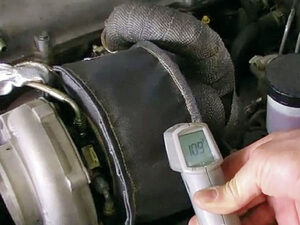
Turbo Blankets or Beanies where introduced for 4 key reasons:
Turbo Blankets have no doubt proved themselves to be very popular with turbo car owners, but will a Turbo Blanket really bring on Boost faster?
Luckily for us, graduate research assistant Steffen Bickle at the University of Texas decided to thoroughly investigate this theory.
Click HERE to read his paper.
The short version is, yes, Turbo Blankets or Turbo Beanies definitely do increase exhaust housing temperatures and help to build boost faster.
Steffan Bickle found that …..”With the turbo blanket mounted, the turbocharger shaft speeds exceeded their baseline counterpart for identical engine operating conditions which resulted in increased boost pressures throughout all tested steady state speed-load point”.
He went on to conclude…”The time-to-torque improvement with the PTP Turbo Blanket was significant, especially for the last case, in which we used a simultaneous tip-in of the speed and the load, the time-to-torque improvement was impressive with an instantaneous torque improvement of up to 140 Nm. This led to an acceleration advantage of 250 engine rpm in spite of the fact that the duration was less than 2.5 s for the entire event. The improvement of the turbocharger performance provided this engine performance advantage because the turbocharger spool-up was faster which resulted in a boost pressure advantage of up to 0.3 bar when the PTP Turbo Blanket was mounted”.
I think that we can safely agree that a Turbo Beanie or Turbo Blanket is a very cheap and easy addition to any Turbocharged Car and the benefits are proven.
Check our the Kool Wrap range of Turbo Blankets or Beanies