0 items - $0.00
No products in the cart.
It holds heat inside the turbine housing so less of that heat radiates into the engine bay. A turbo blanket is an insulated cover that wraps around the hot side of your turbocharger, and that one job protects the parts around the turbo and cuts the heat soak that follows a hard run or a long tow.
This guide explains how a blanket works, the pros and cons, how it compares with a turbo heat shield, and who gets the most from one. If you already know you want one, compare the options in our turbo blanket range.
Some people call it a turbo beanie or a turbo jacket. It is a shaped, multi-layer cover that fits over the turbine housing, the side of the turbo that exhaust gas flows through. Stainless steel springs hold it in place, so it comes off when you need to service the turbo.
A Kool Wrap turbo blanket is built in layers:
| Pros | Cons |
|---|---|
| Less radiant heat reaching hoses, wiring, sensors and plastics | The turbine housing itself runs hotter, which is how it works |
| Cooler intake and intercooler piping running past the turbo | The housing stays hot longer after shutdown |
| Less heat soak after a hard run or a long tow | Oil or fuel soaking into the insulation ruins it and becomes a fire risk |
| Covers the turbo surfaces a split fuel or hydraulic line could spray onto | It only covers the turbo. The manifold and dump pipe still radiate heat |
| Comes off with the springs when the turbo needs servicing | The wrong size or wastegate type leaves gaps or fouls the actuator |
| Suits engines from a WRX to a CAT C15 | It is a heat control part, not a power part |
The rest of this guide works through each of these.
The turbine housing is one of the hottest parts under your bonnet. Exhaust gas flows straight from the manifold into it, and the housing radiates that heat in every direction.
Radiant heat travels in straight lines, like the heat you feel on your face from a campfire. Anything with a line of sight to the housing soaks it up. That includes hoses, wiring looms, the intake pipe, intercooler piping, the bonnet and the firewall.
A blanket puts a thick layer of insulation between the housing and everything around it. Heat stays in the housing and the exhaust gas instead of spreading through the bay. The housing runs hotter under the blanket. The parts around it run cooler.
Less radiant heat from the turbo means a cooler engine bay. You notice this most in tight bays where the turbo sits close to the firewall, the bonnet or a strut tower.
Rubber hoses harden and crack after repeated heat cycles. Wiring insulation turns brittle. Plastic connectors and intake parts soften and warp. Keeping heat in the housing slows that damage, especially on oil and coolant lines, boost and vacuum hoses, and sensor wiring routed near the turbo.
Intake pipes and intercooler piping often run right past the turbine housing. When those pipes absorb radiant heat, the air inside them warms up before it reaches the engine. A blanket cuts the heat those pipes pick up.
Heat soak hits when you stop after a hard drive or a long tow. Airflow through the bay stops, but the turbo is still hot. With a blanket fitted, the heat stored in the housing escapes into the bay more slowly, so nearby parts get less of it.
On trucks, earthmovers and mining gear, a split hydraulic or fuel line can spray onto a hot turbo. A blanket covers the turbo surfaces most likely to ignite a leak. Our CAT C15 blanket is listed as approved for use on all work sites, including mining and tunnel work.
A blanket keeps heat in the turbine housing and the exhaust gas instead of letting it warm the engine bay. Fit one for heat control and component protection, not for extra power.
Both control turbo heat. They do it differently, and plenty of builds use both.
A turbo blanket wraps the turbine housing itself and holds heat inside it. A turbo heat shield sits between the turbo and the part you are protecting, and reflects radiant heat away from it. One insulates the source. The other blocks the path.
| Turbo blanket | Turbo heat shield | |
|---|---|---|
| Where it goes | Directly on the turbine housing | Between the turbo and the part you are protecting |
| How it fixes heat | Insulates, so heat stays in the housing | Reflects radiant heat off the part behind it |
| What it is | Multi-layer fabric with a silica core and stainless mesh | Embossed aluminium panels, single layer 1.8mm up to six layers at 3.3mm |
| How it fits | Stainless steel springs | Brackets or hose clamps on the semi-rigid and pipe shields. Kool Wrap also makes adhesive shields for panels |
| Coverage | The whole hot side of the turbo | The part or area you aim it at |
| Rating | Titanium basalt rated over 1,000°C continuous | DCI pipe shields rated 600°C or 1,000°C, panels to 650°C |
| Oil and fuel | The glass-fibre insulation can absorb a leak, and a soaked blanket must be replaced. The silicone coated outer resists oil and fuel | Not stated |
| Comes off for servicing | Yes, unhook the springs | Yes, unclamp it |
| Best when | You want the whole bay cooler and the turbo protected | You want to protect one specific part, or the turbo works somewhere oily |
Choose a blanket when you want the whole engine bay to run cooler, when the turbo sits close to hoses and wiring on every side, or when a leak spraying onto a hot turbo is the risk you are managing.
Choose a shield when the problem is one specific part, such as a bonnet, a brake line or a master cylinder cooking next to the turbo, or when the turbo works in an environment so oily that a fabric blanket would soak up a leak.
Use both when the turbo is hot enough and packed in tight enough that neither alone is doing the job. Shop embossed semi-rigid heat shields or the turbo blanket range.
Turbo blankets do their job well. They do not fix everything, so know the limits before you buy.
All three use a silica insulation core and a stainless steel mesh inner. The outer layer is what changes.
Turbine housings vary a lot, and model lists overlap between sizes. Before you order, follow our guide on how to measure your turbo for a turbo blanket. When it arrives, our step-by-step guide on how to fit a turbo blanket covers spring fitting, clearance checks and the first heat cycle.
It holds heat inside the turbine housing so less of it radiates into the engine bay. That protects the hoses, wiring, sensors and piping around the turbo, keeps intake air cooler in a tight bay, and reduces heat soak after you switch off.
Yes, at the job they are designed for, which is keeping radiant heat off the parts around the turbo. They do not add power, they do not fix an engine bay with nowhere for hot air to go, and they do not cover the manifold or dump pipe.
They are worth it if you can name the heat problem you are solving. A tight engine bay, hoses and wiring hardening near the turbo, heat soak after towing, or a fire risk from a leak on a work site are all good reasons. If none of those apply, the money is better spent elsewhere.
Kool Wrap blankets use three layers. A heat-resistant outer of titanium basalt, silicone-coated fibreglass or carbon fibre, a 12mm silica insulation core in the titanium basalt and silicone coated ranges, and a stainless steel mesh inner layer against the housing. Titanium basalt and silicone coated models use Kevlar-reinforced stitching.
Neither is better. A blanket insulates the turbo itself and cools the whole area around it. A shield reflects heat away from one specific part. Pick a blanket for general bay heat, a shield to protect one component or where oil would soak a blanket, and both when the turbo runs hot in a tight space.
We would not. A blanket has to hold its shape on a turbine housing under sustained exhaust heat, take spring tension without tearing, and keep its insulation out of the wastegate linkage. Home-made covers made from wrap or matting come loose, foul the actuator, or absorb oil and become a fire risk. A properly shaped blanket comes with springs and fitting instructions.
No. The turbine housing is built to run hot, and the blanket keeps that heat where it belongs. What does cause damage is a poor fit that fouls the wastegate actuator, or a blanket that has soaked up oil from a leak. Fix leaks first and check the wastegate moves freely after fitting.
Browse Kool Wrap turbo blankets or call us on 1300 44 33 34 with your engine, turbo model and a photo of the turbine housing. We keep standard designs and can modify them or custom-make a blanket for larger turbos.
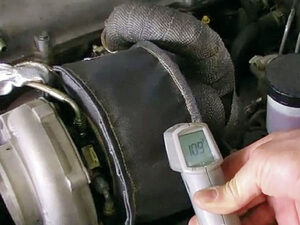
Here at Kool Wrap, we intend to embark on a series of bench tests to evaluate the performance of all of our heat protection products. But while we arrange the equipment to start these tests, we found a great video from the guys at Engineering Explained- a well known Youtube channel- where they used an Infrared camera and temperature data logger to test the heat generated by their Turbocharged GTi VW with and without a turbo blanket.
They used a Titanium Basalt Turbo Blanket of exactly the same construction as our Kool Wrap blankets. The results were definitely impressive.
The turbocharger without the blanket showed exhaust housing temps up to 500°C and these dropped to 160-200°C with the blanket fitted. This reduced engine bay heat was then shown to reduce the temperatures of nearby coolant hoses, the turbo to intercooler piping, the air intake and turbo oil lubrication line.
Check out the video below. The guys did a great job.
Turbo Blankets or Beanies where introduced for 4 key reasons:
Turbo Blankets have no doubt proved themselves to be very popular with turbo car owners, but will a Turbo Blanket really bring on Boost faster?
Luckily for us, graduate research assistant Steffen Bickle at the University of Texas decided to thoroughly investigate this theory.
Click HERE to read his paper.
The short version is, yes, Turbo Blankets or Turbo Beanies definitely do increase exhaust housing temperatures and help to build boost faster.
Steffan Bickle found that …..”With the turbo blanket mounted, the turbocharger shaft speeds exceeded their baseline counterpart for identical engine operating conditions which resulted in increased boost pressures throughout all tested steady state speed-load point”.
He went on to conclude…”The time-to-torque improvement with the PTP Turbo Blanket was significant, especially for the last case, in which we used a simultaneous tip-in of the speed and the load, the time-to-torque improvement was impressive with an instantaneous torque improvement of up to 140 Nm. This led to an acceleration advantage of 250 engine rpm in spite of the fact that the duration was less than 2.5 s for the entire event. The improvement of the turbocharger performance provided this engine performance advantage because the turbocharger spool-up was faster which resulted in a boost pressure advantage of up to 0.3 bar when the PTP Turbo Blanket was mounted”.
I think that we can safely agree that a Turbo Beanie or Turbo Blanket is a very cheap and easy addition to any Turbocharged Car and the benefits are proven.
Check our the Kool Wrap range of Turbo Blankets or Beanies