0 items - $0.00
No products in the cart.

Woven fibreglass rated to 540°C continuous and 980°C intermittent. This is the value choice for street cars, motorcycles, diesel heater exhausts and pipework further from the manifold. Comes in black, white and natural (light tan), in 25mm and 50mm widths, with roll lengths from 4.5m to 15m.
Shop Now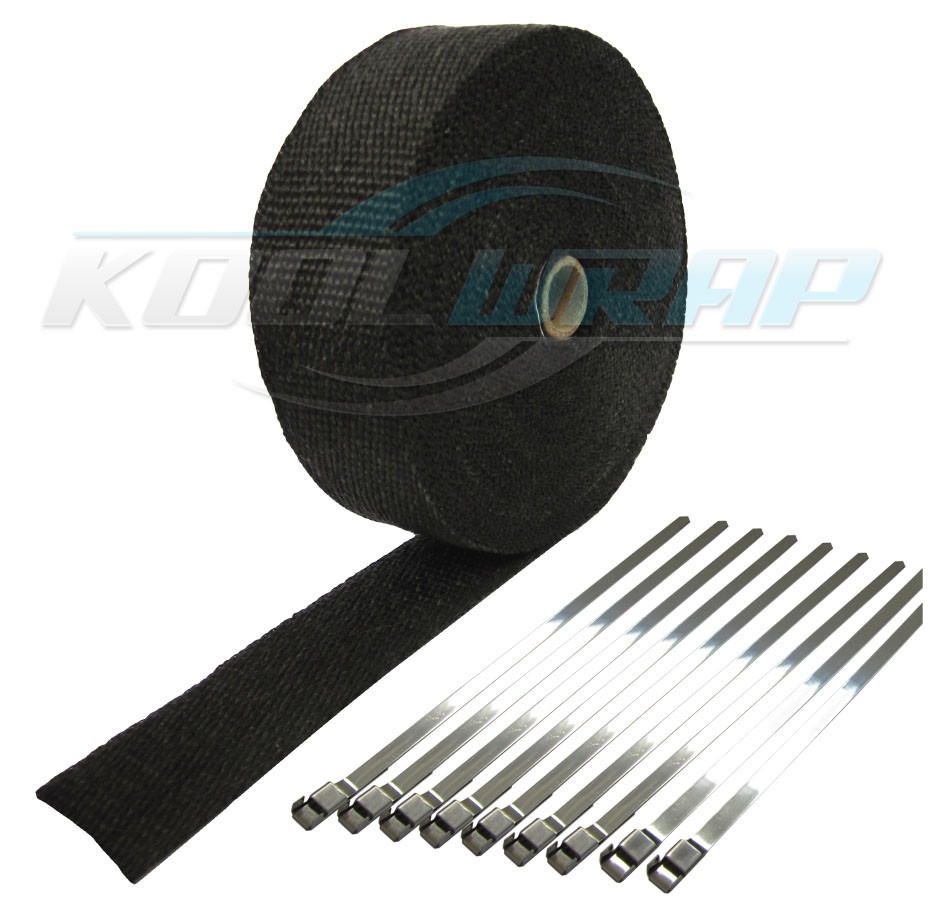
A vermiculite coating over the fibreglass lifts the rating to 650°C continuous and 1,090°C intermittent, in graphite black. Choose it for extractors and headers on performance engines, where standard wrap would sit close to its limit. Available in 50mm width, in 7.5m and 15m rolls.
Shop Now
Woven from basalt fibre, made from volcanic rock, and rated to 980°C continuous. It is the strongest wrap in the range, so choose it for turbo manifolds, dump pipes, motorsport and heavy diesel exhausts. The 3mm x 30m rolls in 50mm, 75mm and 100mm widths suit trucks, boats and industrial plant.
Shop NowExhaust heat wrap keeps heat inside your pipes and away from the engine bay, the cabin floor and the parts around them. Choose from three materials: standard fibreglass rated to 540°C continuous, vermiculite coated fibreglass rated to 650°C continuous, and titanium basalt fibre rated to 980°C continuous. Rolls come in 25mm and 50mm widths, and most include stainless steel locking ties. For trucks, boats and plant, 3mm heavy duty lagging comes in 30m rolls. Not sure which wrap you need? The buying guide below walks you through it.
Engines and exhaust systems generate extreme heat, which can damage nearby components, reduce efficiency, and increase maintenance costs. Kool Wrap’s premium range of exhaust wraps and exhaust heat wraps is designed to manage temperatures, protect sensitive parts and improve performance.
Pick your wrap by the heat it has to handle first. Then choose the width and roll length. Pipes run hottest closest to the engine, so extractors, turbo manifolds and dump pipes need a higher rating than a tailpipe or a diesel heater exhaust. For real-world figures, see how hot your exhaust gets.
Woven fibreglass rated to 540°C continuous and 980°C intermittent. It comes in black, white and natural (light tan). This is the value choice for street cars, motorcycles, diesel heater exhausts and pipework further from the manifold. Shop standard fibreglass exhaust wrap.
A vermiculite coating over the fibreglass lifts the rating to 650°C continuous and 1,090°C intermittent. It comes in graphite black. Choose it for extractors and headers on performance engines, where standard wrap would sit close to its limit. Shop vermiculite coated exhaust wrap.
Woven from basalt fibre, made from volcanic rock, and rated to 980°C continuous. It is the strongest wrap in the range. Choose it for turbo manifolds, dump pipes, motorsport and heavy diesel exhausts. The 3mm x 30m rolls in 50mm, 75mm and 100mm widths suit trucks, boats and industrial plant. Shop titanium basalt exhaust wrap.
| Wrap | Material | Continuous rating | Intermittent rating | Thickness | Widths | Roll lengths | Colours | Best for |
|---|---|---|---|---|---|---|---|---|
| Standard fibreglass | Woven fibreglass | 540°C | 980°C | 1.5mm (3mm heavy duty lagging) | 25mm, 50mm (lagging 50, 75, 100mm) | 4.5m to 15m (lagging 30m) | Black, white, natural | Street cars, motorcycles, diesel heaters |
| Vermiculite coated | Fibreglass with vermiculite coating | 650°C | 1,090°C | 1.5mm | 50mm | 7.5m, 15m | Graphite black | Headers and extractors on performance engines |
| Titanium basalt | Basalt (volcanic rock) fibre | 980°C | 1,150°C | 1.5mm and 3mm | 25mm, 50mm (3mm in 50, 75, 100mm) | 4.5m to 15m, plus 30m | Natural, black | Turbo manifolds, dump pipes, motorsport, heavy diesel |
Use 25mm wrap on pipes up to about 37mm (1.5 inch) in diameter and 50mm wrap on anything larger. The 75mm and 100mm lagging suits large truck, marine and industrial exhausts.
To work out roll length, use this rule: metres of wrap = metres of pipe x pipe circumference in mm ÷ (wrap width minus overlap in mm). One metre of 50mm pipe wrapped with 50mm wrap at a 6mm overlap needs about 3.7m. Add around 10% for bends and tie-offs. Our exhaust wrap installation guide has a table for common pipe sizes.
For ties, a four-cylinder header set typically takes 4 to 8 x 200mm ties and 1 x 400mm tie. Double that for a V8. Top up from our range of stainless steel tie straps.
Quality exhaust wrap typically lasts 2 to 5 years. Trapped moisture, oil or fuel contamination, rubbing and heat above the wrap’s rating all shorten that. Replace wrap that is cracking, fraying, brittle or oil-soaked. Our guide on how long exhaust wrap lasts covers the warning signs.
Match the rating to the heat. Standard fibreglass (540°C continuous) suits most street exhausts and motorcycles. Vermiculite (650°C continuous) suits headers on performance engines. Titanium basalt (980°C continuous) suits turbo manifolds, dump pipes, motorsport and heavy diesel.
Multiply the pipe length in metres by the pipe circumference in mm, then divide by the wrap width minus the overlap in mm. One metre of 50mm pipe with 50mm wrap and a 6mm overlap needs about 3.7m. Add about 10% for bends and tie-offs.
No. Kool Wrap exhaust wrap does not need soaking. Some installers dampen it because damp wrap pulls tighter and releases fewer fibres. If you dampen it, run the engine soon after so the heat dries the wrap out. Don’t leave damp wrap sitting on the pipe.
New wrap contains binders that burn off during the first heat cycles. Light smoke and a smell are normal and clear after the first runs. If smoke continues, check for oil or fuel on the wrap.
Correctly fitted wrap does not damage headers in normal use. The two real risks are moisture held against bare mild steel, which speeds up rust, and heat fatigue on thin-wall headers in sustained race use. Read can exhaust wrap damage extractors or headers for prevention steps.