0 items - $0.00
No products in the cart.
How long does exhaust wrap last? Quality exhaust wrap typically lasts 2 to 5 years. Where yours lands in that range comes down to four things. How dry it stays, whether oil or fuel reaches it, how well it was fitted, and how hot the pipe runs compared with the wrap’s rating.
This guide explains what shortens wrap life, how the materials compare, the signs it is time to replace, and how to get more years from the next wrap. You will find ratings and roll sizes for every material in the Kool Wrap exhaust heat wrap range.
Wrap soaks up water from rain, creek crossings, washing and condensation. On a vehicle you drive often and hard, the heat drives that water out. Trouble starts when the wrap stays damp. A weekend car in a cold shed, a 4WD after a river crossing, or a ute that only does short trips never gets the pipe hot for long enough. Water held against mild steel speeds up rust, and the rust then stains the wrap from the inside.
A weeping rocker cover gasket or a messy oil change drips straight onto extractors. Wrap absorbs oil and fuel. Once it is soaked, it smokes and smells every time it heats up, and it becomes a fire risk. Replace oil-soaked wrap straight away and fix the leak first.
Wrap that rubs on a chassis rail, crossmember, engine mount or heat shield wears through. Off-road, rocks and scrub tear at exposed wrap under a 4WD. Wrap near a flex joint gets worked every time the exhaust moves, which is one reason to leave flex joints bare.
Loosely wound wrap moves on the pipe, lets water sit between the turns and frays at the edges. Once a turn lifts, the rest follows. Keep tension even, overlap about 6mm per turn and lock both ends with stainless ties.
Every wrap has a continuous temperature rating. Run a pipe above it for long periods and the fibres break down faster. Turbo systems, race use and heavy towing push more sustained heat through the pipe than highway cruising does.
Wrap does not fail evenly along a system. Check these places first.
| Location | Why it wears | What you will see |
|---|---|---|
| Extractor primaries near the head | Hottest part of the system and closest to oil leaks | Brittle weave, oil staining, discolouration |
| The outside of tight bends | Thinnest coverage and most tension during fitting | Gaps opening between turns, frayed edges |
| Under the car near the floor | Road spray, stone chips and water | Damp wrap, rust bleed, torn edges |
| Where wrap passes a mount or crossmember | Rubbing every time the exhaust moves | A worn line across the weave |
| Mufflers and rear sections | Runs cooler, so water sits in the wrap instead of drying out | Sagging, loose ties, damp patches |
Rear sections and mufflers run cooler than the headers, so water is the main thing that shortens wrap life there rather than heat.
Choose a wrap with headroom above how hot your pipe runs for long periods. A wrap working near its limit on every drive will not last as long as the same wrap running well inside it.
| Wrap | Continuous | Intermittent | Colours |
|---|---|---|---|
| Standard fibreglass | 540°C | 980°C | Black, white, natural |
| Vermiculite coated fibreglass | 650°C | 1,090°C | Graphite black |
| Titanium basalt fibre | 980°C | Not published | Natural, black |
The everyday wrap for street cars, bikes and general use. It comes in 25mm and 50mm widths at 1.5mm thick.
Vermiculite coated fibreglass exhaust wrap is fibreglass coated with a vermiculite dispersion. The coating lifts the continuous rating to 650°C, which gives more headroom on hotter street and performance systems. It comes in 50mm width only.
Titanium basalt fibre exhaust wrap is made from basalt, a volcanic rock, spun into fibre. It carries the highest continuous rating in the range at 980°C, and Kool Wrap’s product listing describes it as 25% stronger than regular wraps. Pick it for turbo dump pipes, race cars and industrial pipework.
Check the wrap every time the vehicle is on a hoist or due for an oil change. Replace it if you see any of these:
A new wrap smokes for its first few heat cycles as binders burn off. Smoke after that points to oil or fuel in the wrap.
Most early failures trace back to fitting and moisture. Our guide to whether exhaust wrap can damage extractors explains how to protect the pipe underneath as well as the wrap.
For the full method, including how much wrap to buy and how many ties you need, follow our step-by-step exhaust wrap install guide.
Quality exhaust wrap typically lasts 2 to 5 years. A street car that gets driven regularly and stays dry sits at the top of that range. A weekend car in a damp shed, a 4WD that crosses water, or wrap near an oil leak sits at the bottom.
Replace it when it shows the signs above rather than on a fixed schedule. Inspect it at every service and note the date you fitted it, so you know how old it is.
No. Once wrap has been through heat cycles it is brittle, and unwinding it damages the weave. The stainless ties cannot be reused either, because you cut them to remove them.
It can. A car that sits gets condensation on the pipes and never runs hot enough to dry the wrap out. That is the single most common reason wrap fails early on a weekend car.
Light smoke over the first few heat cycles is binders burning off and it clears. Smoke that keeps going, or smells of burnt oil or fuel, means something has soaked into the wrap or an exhaust leak is blowing onto it. Find the source before you keep driving.
Not sure whether your wrap is due, or which material will last longer on your setup? Send Kool Wrap a photo or call 1300 44 33 34. Replacement rolls in all three materials are in the exhaust heat wrap range.
Wrapping super hot engine exhaust pipes in a high temperature resistant insulating tape has become more popular recently for a number of reasons.
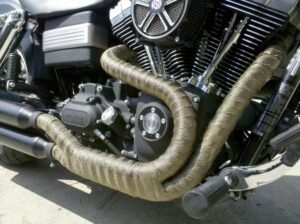
Kool Wrap manufacturers a range of wraps with the Basalt Titanium Wrap being the highest quality wrap in the range.
Remarkably, Basalt (often known as Lava Rock) is produced by melting down carefully chosen rock formations that are the result of volcanic activity. The molten rock is then forced through an extruding machine to produce very fine strands of glass fibre that are then woven into various products. These strands have a filament diameter of 10-20um which is far enough above the respiratory limit of 5um to make it suitable replacement for asbestos.
Basalt fibers are known to be 25% stronger than regular glass fibers and are often used in producing composites that are very similar to carbon fibre.
Wikipedia also quotes, Basalt Fibres “……….also have a high elastic modulus, resulting in excellent specific strength—three times that of steel. Thin fiber is usually used for textile applications mainly for production of woven fabric. Thicker fiber is used in filament winding, for example, for production of CNG cylinders or pipes. The thickest fiber is used for pultrusion, geogrid, UD, multiaxial fabric production and in form of chopped strand for concrete reinforcement. One of the most prospective applications for continuous basalt fiber and the most modern trend at the moment is production of basalt rebar that more and more substitutes traditional steel rebar on construction market.